I agree with @Nick Cox. Here are a couple of thoughts to help you move forward:
- It's better to assess the standardized residuals for normality rather than the unstandardized residuals, as you do here. (You might also benefit from reading my answer here: Interpreting plot.lm().)
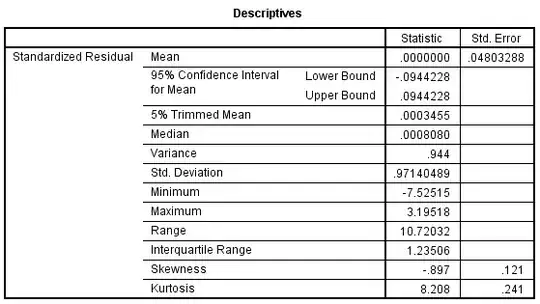
- It is somewhat problematic to interpret kurtosis in the presence of skewness. (There is good information on skewness and kurtosis here.) Although the skewness of your sample may see only 'moderate' by conventional schemes (i.e., between -.5 and -1), the standard error of the skewness is .121, so your sample is 7.4 SEs from 0. Note that your minimum value (-4) is much further from your mean than your maximum value (1.7), and the mean (0) is below your trimmed mean (0.0002), which is below your median (0.0004).
Some suggestions:
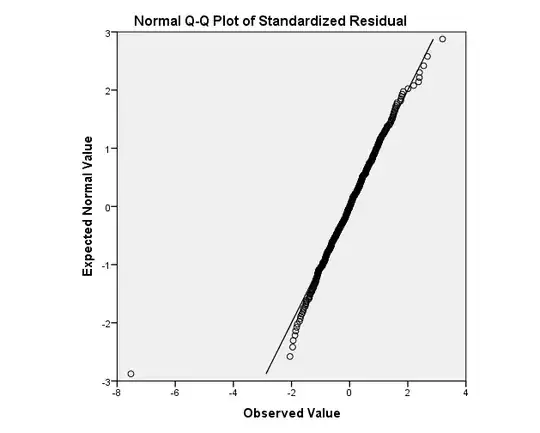
Try assessing the standardized residuals, and also look at a qq-plot. (@Glen_b has a nice display of various possibilities for qq-plots here: How to interpret a QQ plot. I have also provided some information on the construction and interpretation of qq-plots here: QQ plot does not match histogram, and here: PP-plots vs. QQ-plots. Note that these three answers assume the theoretical distribution is on the x-axis and your data are on the y-axis, which is flipped relative to your plot.)
a. If you seem to have a couple outliers, but the rest of the distribution seems fine, try using robust regression. (You may want to search / read through some of the threads already on CV categorized under the robust tag.)
b. If the whole distribution is skewed in a smooth and continuous way, you might try a transformation, such as from the Box-Cox family of transformations, and use standard regression methods with the transformed data.
Update 1: Because the 5% trimmed mean is closer to the untrimmed mean than the median even with the standardized residuals, I suspect b will be the more appropriate option. The qq-plot will give us more information, though.
Update 2: Your biggest issue is a single outlier. You could use robust regression, but you may still have a problem with skewness nonetheless. Try a qq-plot and descriptives for your standardized residuals without that point.