13

I've noticed that a variety of pieces in the classical repetoire (certainly at least the piano repetoire), label what seems to be effectively the same key signature differently. That is, I am not aware of any differences in terms of key between a piece in "G Sharp major" and "A flat major" (or their equivalent minors). Is there any reason that sometimes a sharped key signature is used while at other times the equivalent flatted key signature is used?

As a related point, I have undoubtedly noticed the preference of certain "equivalent" key signatures over others. For example, one encounters "E flat" significantly more than "D sharp" and likewise "C sharp" significantly more than "D flat". Is there any particular reason for this, or is it simply a convention that has been handed down to use through musical history?

Alex Basson
  • 20,656
  • 2
  • 59
  • 101
Noldorin
  • 1,124
  • 11
  • 22

4 Answers4

32

The short (and oversimplified) answer is: Because Ab Major has fewer flats than G# Major has sharps, and thus it's easier for musicians to read. This becomes especially apparent with keys such as D# Major, which has a double-sharp in it---the seventh note of the D# Major scale is not D, but Cx (that's "C double-sharp").

The longer and more accurate answer is that these keys are not in fact equivalent. Only in an equal-tempered tuning system do G# and Ab have the same pitch, Eb and D# have the same pitch, etc. That is, only in equal temperament do enharmonically equivalent notes actually have the same pitch. In every other tuning system, the enharmonically equivalent notes are slightly (but definitely noticeably) different from each other. If you've only been exposed to fixed-pitch instruments such as the piano and the guitar, this concept can be challenging at first, but violinists, wind, and brass players know that their intonation depends on the context of the key in which they're playing.

This in turn leads to different keys having different sonic characteristics. In the modern, equal-tempered era, we've mostly lost these distinctions, but to composers of two hundred years ago and more, the keys of Ab and G# didn't sound the same at all, and they would compose to a specific key in order to take advantage of its particular character.

Update: In response to Brian's comment, I thought it would be helpful to post an example. Here are links to YouTube videos, all three of which were posted by the same person, using the same synthesizer, all three playing Bach's Air on the G String. But each link uses a different tuning system:

Alex Basson
  • 20,656
  • 2
  • 59
  • 101
  • Good answer: consider also that pieces with key changes in the middle are often set up so that the different keys are related in some way. This often necessitates the use of one key over the enharmonic spelling. – NReilingh Jun 03 '11 at 03:39
  • And in that time, I decided to ask that as [a separate question](http://music.stackexchange.com/questions/2993/examples-of-songs-or-phrases-played-in-different-temperaments) rather than just a comment. Perhaps you could provide your update as an answer to that question. – Brian Campbell Jun 03 '11 at 16:41
  • Thanks for the great answer. Equal temperement does indeed seem to be the key here! As a piano player, one just wouldn't generally notice it without having been taught music history/theory. – Noldorin Jun 04 '11 at 16:03
  • Yes, before equal temperament a work played in G# and any *other key* would sound different (different intervals between scale notes), but G# and Ab are identical keys on a keyboard, producing identical pitches. You are essentially arguing that, after playing a piece in G#, keyed instruments would be re-tuned before playing in Ab. Is there evidence that that was actually done? – Steve Clay Nov 14 '13 at 18:33
  • @SteveClay It's not so much that performers would retune to play in Ab as it is that they would choose a program of pieces in related keys and then have the harpsichord tuned (or more likely, tune it themselves) so that all the pieces in that program would sound pretty good. In fact, performers playing in period style continue this practice to this day. – Alex Basson Nov 14 '13 at 19:24
  • Interesting! So do you know if certain keys are chosen by the composer because of the common intonation choices of the performers? –  Mar 28 '16 at 20:13
8

There is a strong case for certain enharmonic key uses depending on the mode (minor/Major).

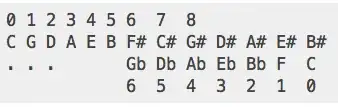
These four little tables show that Eb is significantly easier to write than D# for a major scale as the latter would involve double sharps in the signature.

But F# and Gb Major are really close in complexity.

Major scales

Number of #s (upper lines) versus enharmonic number of bs

a

Number of bs (upper lines) versus enharmonic number of #s

b

Likewise C# minor is to be prefered to Db minor but D# and Eb are interchangeable and this is indeed what Bach did in its Well Tempered Keyboard (Preludium 8 and Fugue 8, BWV 853). He used one for the prelude and the other for the fugue (See Alex Basson's answer about the validity of this substitution).

Minor scales

Number of #s (upper lines) versus enharmonic number of bs

c

Number of bs (upper lines) versus enharmonic number of #s

d

It explains that one favor keys that are practical in both modes especially in styles when it is frequent to make modulations or to switch between modes, such as variations.

ogerard
  • 8,658
  • 4
  • 35
  • 67
  • Ah, I knew enharmonic was the fancy theoretical term I was looking for! Looks like a good reply, but I'm about to doze off here, so will read tomorrow. – Noldorin Jun 03 '11 at 00:36
  • I think it's important to say, though, that Bach was trying to make a point with the Well-Tempered Clavier. Up until that time, musicians did not consider D# and Eb interchangeable, as indeed they are not unless one is using equal temperament. – Alex Basson Jun 03 '11 at 01:55
  • Also, I find the tables a bit confusing. The first one, for example, seems to imply that Ab Major, say, has 4 sharps. I can only assume that you mean to say that Ab has four altered notes (all flats) while its enharmonic equivalent, G#, has eight altered notes (all sharps). – Alex Basson Jun 03 '11 at 01:58
  • Regarding "He used one for the prelude and the other for the fugue"... which BWV? – James Tauber Jun 03 '11 at 05:48
  • @Alex: I agree with your comment and your answer. I did not repeat the point about the equal temperament because you made it already and it was in the context of the piano literature but I have edited my answer. You correctly interpreted the tables but I have also added a few words to explain their meaning. I hope they will be less confusing that way. – ogerard Jun 03 '11 at 07:57
  • 1
    Okay, so this seems pretty logical: using a fewer number of accidentals in the key signature. I think this is more or less the best reason. :-) – Noldorin Jun 04 '11 at 16:02
6

This is a great question that is subtlely different from the usual "what is the difference between A♭ and G♯?" Apart from frequency differences in non-12-et tunings, that question relates to the function of the note within the chord/scale/key.

But if we're talking about choice of key, then there are other factors at work. Obviously in non-12-et tunings, the choice of A♭ major vs G♯ major does have to do with how it will sound. But let's assume 12-et for the rest of this answer.

There are three general factors that, I would have thought (but see below about Bach), led a composer in the common practice era to choose one key over another enharmonic one:

  • avoid double sharps and double flats in the key signature itself
  • reduce double sharps and double flats in the keys to be modulated to
  • reduce double sharps and double flats in the keys used by transposed instruments

As others have mentioned, the Well-Tempered Clavier is interesting here. The point of the piece was to demonstrate the 12-major and 12-minor keys on an instrument where enharmonic notes have the same frequency. So frequency-wise there really can only be 12 major keys.

But from a naming point of view (assuming you wouldn't be as crazy as to have double sharps or double flats in your tonic) you have 21 possible key names for each of major and minor.

How would one go about choosing which 12 key names out of 21 to use? First step might be to avoid double sharps and double flats in the key signature itself. Note that the result is different between major and minor keys (as WTC demonstrates). That reduces your choice from 21 to 15 (so G♯ D♯ A♯ E♯ B♯ F♭ majors are out)

Then it likely just comes down to what you're going to modulate too. If you are going to modulate to V, you might want to avoid having to introduce the double-sharp to do so (which means C♯ major is out). If you are going to modulate to V of V, then F♯ might be out too).

All that said, it makes it particular interesting that WTC does use C♯ major and F♯ major and instead eschews D♭ G♭ C♭ to get from 15 possibilities to 12. The C♯ major prelude and fugue does indeed need a double-sharp in modulated passages, even though the note is diatonic.

In the case of ensemble pieces with transposing instruments: imagine a clarinet part in concert C♯ major :-)

James Tauber
  • 3,077
  • 1
  • 17
  • 25
  • Thanks for the answer. I think your justification is pretty good, in general, though it is interesting how seemingly common C# major is as a key signature... WTC is far from the only example. What do you mean by modulate btw? I haven't encountered this term before in music. – Noldorin Jun 04 '11 at 16:01
  • Modulation is the process of changing the key within a piece (e.g. from the tonic to the dominant). See [en.wikipedia.org/wiki/Modulation_(music)](http://en.wikipedia.org/wiki/Modulation_(music)) for a lot more information. – James Tauber Jun 04 '11 at 20:45
  • I've cleaned up the comments. –  Jun 29 '11 at 22:17
2

Some of the answers have touched upon convenience for the player, but have missed one point about this. In making arrangements band and orchestral arrangements, I have found that wind players often prefer sharps to flats, preferring for example 7 sharps over 5 flats. This is noticeable particularly with transposing instruments. String players, on the other hand, seem to prefer flat keys to sharp ones.

Colin Fine
  • 129
  • 3
  • Do you know why this preference exists? –  Jun 03 '11 at 13:21
  • @Matthew: this is not strictly true about string players, but certain sharp keys can be awkward, especially in linked arpegio, and do not resonate well with open chords but the difference blurs when you progress in skill. Double-bass players have different tastes than violin/viola/cello because they have a different tuning. – ogerard Jun 04 '11 at 16:29
  • I always anecdotally thought string players preferred sharps. Not sure where I picked up that impression, though. – James Tauber Jun 04 '11 at 20:46
  • 1
    -1: As a wind specialist, I will say that wind bands universally prefer flat keys over sharp keys. Many band instruments are keyed in Bb or Eb, which makes concert Eb the overwhelmingly popular band key in middle-school level ensembles. – NReilingh Jun 05 '11 at 23:27
  • @NReilingh - you are missing the point. The instruments are keyed in Bb or Eb, so their parts will have two or three more sharps (or two or three fewer flats) than concert. If a piece is in D, say, an Eb part will be in five sharps. What I'm saying is that wind players do not seem to be too unhappy with five sharps. I think your downvote is unwarranted. – Colin Fine Jun 20 '11 at 10:50
  • 1
    @Colin, I fully understand how key signatures translate for transposing instruments; my issue is that I think you've got the instrument families mixed up. The other comments above seem to agree with this (also given that string instruments' open strings are the roots of sharp scales), and my personal experience as a wind instrumentalist and educator contradicts what you have suggested in your answer. – NReilingh Jun 20 '11 at 11:20
  • Wind players get accustomed to sharp key signatures, because Bb and Eb instruments read two or three more sharps than the real key. And a composer or copyist preparing a clarinet or sax part will naturally transpose "up one" unless it leads into an impenetrable forest of double (or even triple) sharps. Because of this, we need not worry if an alto sax part ends up in 7 sharps, with a smattering of double sharps - they're used to it! But equally, we don't have to protect a wind player from flats. They're no problem for anyone but an absolute beginner, really! – Laurence Payne Mar 04 '15 at 13:03
  • Re Colin's answer - you never defined whether the key was the key of the piece, or the key the instruments part is written in to compensate. E.g. if the tune is basically in G maj., the trumpet part would be written in A .My experiece says that horn players prefer to read in flats, whereas guitarists prefer sharps - every open string on a guitar is the tonic of a # key, and it's maybe easier to sharpen a guitar note than flatten it, but brass players find it easier to flatten notes. – Tim Mar 01 '12 at 13:45
  • Sorry, Tim, but that really is rubbish. I'm a brass player. There's a valve combination (or trombone slide position) for each note. (OK, sometimes a choice of several.) You put down those valves, you blow the note. That's it. We don't take an E and flatten it, we just play Eb. And, although a violinist may initially learn open notes, then add other notes with a shift from that base position, I'm sure it isn't long before they just see the note - put a finger in the right place. You can over-think this sort of thing! – Laurence Payne Mar 06 '15 at 13:40