One more thing to add is that an edge detection is usually defined more or less like from Wikipedia:
Identifying points in a digital image at which the image brightness changes sharply or, more formally, has discontinuities.
They have a nice illustration:
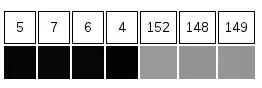
Here, the edge is between $4$th and $5$th pixel (or, between $3$rd and $4$th, if you count $0$-based). (because the gradient is 2 1 2 148 4 1).
What I want to say, is that what you refer to as "thick" edges, will most likely be detected as two edges. As an example, take a look at these example images from the Wikipedia Canny page:


Note the bars going out of the valve (the long thin white structures), and note how in the edge detection result, they are detected as two lines (outer and inner edge).
This can, of course, be avoided, combining the blurring (the $\sigma$ parameter) and some edge thinning techniques. After you blur the image, what was once a wide, sharp edge having just one peak in gradient will now have a gradient slowly reaching maximum and then slowly dropping towards zero.
If there was no blurring, the gradient would be e.g.
2 1 3 130 4 2 3 111 2 0 2.
After blurring, the gradient might look like:
2 1 2 50 85 120 94 63 12 2 0.
In the after-blurring the edge detector will detect a $5px$ long edge. If you want to get just the location of the edge marked by $1px$ wide line, the edge supressing technique is what finds the "maximum" in your blurred-edge gradient and marks the middle pixel (e.g. one with gradient $120$) as the actual edge.
Hope this helps.